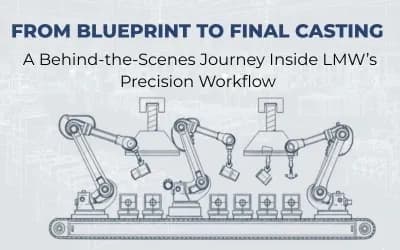
Every world-class casting begins long before molten metal meets mould. At LMW Foundry, the journey from design blueprint to final component is a carefully engineered process built on precision, science, and decades of metallurgical expertise. What appears as a simple metal part is, in reality, the final product of an intricate workflow involving simulation, moulding, melting, metallurgy, machining, and multi-stage inspection.
In this exclusive behind-the-scenes look, we walk through the end-to-end LMW Foundry workflow — a process trusted by global OEMs across marine, locomotive, pump, valve, and energy industries.
Step 1 - Blueprint & Design Review: Turning Concepts into Manufacturable Castings
Every project begins with a detailed blueprint from the customer. LMW's engineering team collaborates closely to understand:
- functional requirements
- load conditions
- environmental stress factors
- dimensional accuracy expectations
- material specifications
The goal is simple: ensure the design is ready for flawless manufacturability.
What sets LMW apart is its integrated approach. Instead of simply accepting a drawing, the team conducts design manufacturability (DFM) studies to fine-tune geometry, reduce defects, and optimize metal flow. This early intervention significantly enhances casting reliability.
Step 2 - Casting Simulation: Predictive Engineering for Zero-Defect Castings
Once the blueprint is approved, it enters the digital world. LMW Foundry uses advanced casting simulation tools to predict:
- solidification patterns
- metal flow behavior
- shrinkage possibilities
- hotspot formation
- turbulence areas
This predictive modelling allows engineers to refine the gating system, riser placement, and mould design before a single mould is made. Simulation is one of the strongest pillars of LMW’s precision workflow, ensuring superior casting integrity and minimal rework.
Step 3 - Pattern Development: Crafting the Foundation of Accuracy
The final simulation output becomes the base for pattern creation. Patterns are developed using:
- CNC machining
- polyurethane boards
- high-accuracy wooden or metal patterns
LMW’s experienced pattern makers ensure:
- smooth surface finish
- dimensional consistency
- long-term durability for repeated use
A precise pattern is the foundation of an accurate casting — and LMW’s pattern shop is built to deliver absolute consistency batch after batch.
Step 4 - Moulding Excellence: Fast Loop Line & Hand Moulding Expertise
LMW’s moulding capabilities include: Fast Loop Line (FLL) for high-volume, high-precision components
FLL ensures:
- consistent mould hardness
- uniform sand distribution
- high moulding speed
- repeatability
- dimensional accuracy
Hand Moulding for large, complex castings Used especially for:
- marine housings
- locomotive components
- oversized pump/valve bodies
The combination of automation + craftsmanship ensures flexibility across component sizes and complexities.
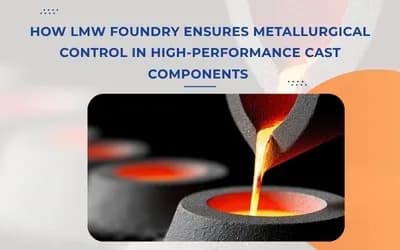
Step 5 - Melting & Metallurgy: The Science Behind Strength and Performance
Melting is where the art of casting meets metallurgy. LMW Foundry uses:
- high-performance induction furnaces
- strictly controlled melt temperatures
- advanced spectrometer analysis
The metallurgical lab conducts:
- chemical composition checks
- microstructure evaluation
- nodularity & tensile strength analysis
- hardness checks
This ensures that every heat meets international quality standards and specific customer requirements. Metallurgy is one of LMW’s greatest strengths — and a key differentiator in its precision workflow.
Step 6 - Pouring & Solidification: Controlled Precision
The molten metal is poured into the prepared moulds with meticulous process control:
- controlled pouring temperature
- smooth ladle handling
- consistent pouring rates
- real-time monitoring of melt behavior
This stage defines the final strength and integrity of the component. Controlled solidification ensures:
- uniform grain structure
- minimal porosity
- reduced internal stresses
Step 7 - Knockout, Fettling & Cleaning: Shaping the Final Form
After solidification, the casting moves through:
Knockout: Breaking the mould to free the casting.
Fettling: Removing gates, risers, and excess material through cutting, grinding, and shot blasting.
Surface Finishing: Achieving smoothness, dimensional tolerance, and readiness for machining.
Each component is handled with precision to maintain structural integrity.
Step 8 - Machining & Dimensional Accuracy: Achieving Final Tolerances
After fettling, the component undergoes machining operations using CNC machines and precision tools.
LMW ensures:
- tolerance accuracy
- perfect fitment
- smooth mating surfaces
- consistency across batches
The machining stage transforms a raw casting into a ready-to-assemble industrial component.
Step 9 - Inspection & Quality Control: Zero-Compromise Standards
The final casting is verified through multi-stage inspection:
Non-Destructive Testing (NDT)
- ultrasonic testing
- radiography
- magnetic particle testing
- dye penetrant testing
Dimensional Inspection
- CMM (Coordinate Measuring Machine)gauges & fixtures
- profile projectors
Mechanical Testing
Every component must pass LMW’s zero-defect philosophy before dispatching.
Step 10 - Packing & Dispatch: Delivering Reliability Worldwide
Once approved, the component is securely packed to withstand transit conditions, especially for:
- marine equipment
- locomotive parts
- heavy industrial assemblies
LMW delivers castings to global clients who rely on consistent performance and long-term reliability.
Precision Is Not a Step - It Is the Entire Workflow
The journey from blueprint to final casting reflects LMW Foundry’s commitment to engineering excellence. Through simulation-led design, robust metallurgy, advanced moulding, and stringent quality control, LMW ensures every component meets the highest global standards. This behind-the-scenes workflow demonstrates why leading industries trust LMW for precision, consistency, and reliability.