
How 3D Scanning is Revolutionizing Reverse Engineering in Precision Casting?
JULY 13, 2026
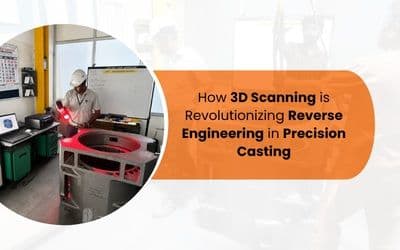
In the modern foundry industry, precision, speed, and innovation are critical to meeting customer expectations. One of the most significant advancements driving this transformation is 3D scanning technology, particularly in the field of reverse engineering. For precision casting manufacturers, 3D scanning has become a powerful tool for recreating components, improving designs, and reducing development time while maintaining exceptional accuracy.
What is Reverse Engineering?
Reverse engineering is the process of creating a digital model from an existing physical component. In many industries, manufacturers often need to reproduce parts when original drawings, CAD files, or design data are unavailable. This is especially common with legacy equipment, worn-out components, or imported machinery where technical documentation may be limited.
Traditionally, reverse engineering involved manual measurements and extensive engineering effort. Today, 3D scanning has streamlined the process, making it faster, more accurate, and highly efficient.
The Role of 3D Scanning in Precision Casting
3D scanning uses advanced optical or laser-based technology to capture millions of data points from a component's surface. The collected data is converted into a highly detailed digital model that can be used for design, analysis, tooling development, and manufacturing.
For foundries producing complex precision castings, this technology offers a significant advantage by accurately capturing intricate geometries that are difficult to measure using conventional methods.
Key Benefits of 3D Scanning in Reverse Engineering
1. Faster Product Development
Speed is a major advantage of 3D scanning. Components that once required days of manual measurement can now be digitized within hours. Engineers can quickly generate CAD models and move directly into design validation, tooling development, or production planning.
This accelerated workflow helps reduce lead times and improves responsiveness to customer requirements.
2. Accurate Replication of Complex Components
Precision cast parts often feature intricate shapes, curved surfaces, internal channels, and detailed contours. 3D scanning captures these complex geometries with exceptional accuracy, ensuring that the digital model closely matches the original component.
The result is a more reliable reverse engineering process and higher-quality castings.
3. Recreating Obsolete Parts
Many industries continue to operate equipment for decades, often facing challenges when replacement parts are no longer available. With 3D scanning, foundries can digitize existing components and recreate accurate models for manufacturing replacement castings.
This capability extends equipment life and helps customers avoid costly downtime.
4. Improved Tooling and Pattern Development
Accurate digital models form the foundation for developing patterns, molds, and tooling used in precision casting. By leveraging 3D scanning data, manufacturers can create tooling with greater precision, reducing errors and minimizing rework during production.
This leads to improved casting quality and enhanced process efficiency.
5. Enhanced Quality Inspection
Beyond reverse engineering, 3D scanning also supports quality control. Finished castings can be compared against the original CAD model to identify dimensional deviations and ensure compliance with specifications.
This enables foundries to detect issues early, improve process control, and consistently deliver high-quality components.
Applications Across Industries
The combination of 3D scanning and reverse engineering is widely used across various sectors, including:
- Aerospace components
- Automotive castings
- Pumps and valves
- Energy and power equipment
- Industrial machinery
- Heavy engineering applications
In each of these industries, precision, reliability, and speed are essential, making 3D scanning an invaluable technology.
Driving Digital Transformation in Foundries
As the foundry industry embraces digital manufacturing and Industry 4.0 practices, 3D scanning is becoming an integral part of the product development process. It bridges the gap between physical components and digital engineering, enabling faster innovation, improved collaboration, and more efficient manufacturing workflows.
By integrating 3D scanning with CAD software, simulation tools, and advanced manufacturing technologies, foundries can create a seamless digital ecosystem that enhances productivity and competitiveness.
Conclusion
3D scanning is redefining reverse engineering in precision casting by delivering unmatched accuracy, faster turnaround times, and greater design flexibility. From recreating obsolete components to improving tooling development and quality inspection, the technology empowers foundries to meet evolving industry demands with confidence.
As manufacturers continue to pursue higher efficiency and precision, 3D scanning will play an increasingly important role in shaping the future of precision casting and foundry operations.