Machine reliability does not begin at assembly—it starts much earlier, at the foundry stage. The strength, accuracy, and longevity of any industrial machine are deeply influenced by the quality of its cast components. This is where Industrial Casting Quality becomes a decisive factor in determining real-world performance, operational stability, and customer satisfaction.
At LMW Foundry, casting is approached as a precision-driven engineering discipline rather than a basic manufacturing step. From molten metal control to final inspection, every stage is designed to ensure machines perform consistently in demanding industrial environments.
Why Industrial Casting Quality is Critical to Machine Reliability?
Industrial machines operate under continuous loads, vibration, and thermal stress. Any inconsistency in casting can directly affect alignment, stiffness, and fatigue of life. Industrial Casting Quality ensures that cast components deliver the mechanical integrity required for long-term machine reliability.
High-quality castings contribute to:
- Structural rigidity
- Reduced vibration and noise
- Improved dimensional stability
- Enhanced machine accuracy over time
These factors collectively influence how reliably a machine performs at the end of user’s facility.
Metallurgical Control: The First Step toward Performance
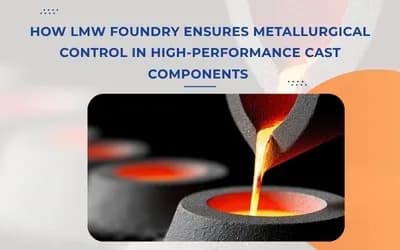
The journey of performance begins with molten metal. Chemical composition, temperature control, and solidification behavior play a vital role in determining final casting properties. At LMW Foundry, metallurgical parameters are closely monitored to ensure uniformity and repeatability across batches.
Strong metallurgical practices support Industrial Casting Quality by minimizing internal defects, improving microstructure consistency, and delivering predictable mechanical performance in every component.
Structural Integrity and Load-Bearing Performance
Core machine components such as beds, columns, and housings must absorb dynamic loads without deformation. Poor casting integrity can lead to stress concentration, premature wear, or even failure.
By focusing on robust mould design and controlled production methods, LMW Foundry ensures castings provide high load-bearing capacity and excellent vibration damping. This structural strength directly enhances machine reliability and operational confidence for end users.
Dimensional Accuracy: Precision that supports Assembly and Performance
Precision machining depends heavily on precision casting. Accurate castings reduce the need for corrective machining and ensure seamless integration during assembly. Industrial Casting Quality at the foundry level improves downstream efficiency while maintaining tight tolerances.
For customers, this results in:
- Faster machine commissioning
- Better alignment accuracy
- Consistent operational output
These advantages translate into measurable performance gains at the shop-floor level.
Consistency Across Volumes: A Key End-User Expectation
End users expect machines to perform the same way today, tomorrow, and years into operation. Achieving this requires consistent casting quality across production volumes. Industrial Casting Quality ensures that every component meets the same standards, regardless of batch size.
Through standardized processes and quality validation systems, LMW Foundry delivers repeatable results that support long-term machine reliability and reduced maintenance costs.
From Foundry Excellence to End-User Value
The true impact of a foundry’s capability is realized at the customer’s facility. Reliable machines, minimal downtime, and predictable performance all trace back to the quality of cast components. By prioritizing Industrial Casting Quality, LMW Foundry directly supports machine builders and end users in achieving higher productivity and operational efficiency.
From molten metal to dependable machines, LMW Foundry plays a critical role in ensuring that casting quality translates into lasting performance and real-world reliability.